> ## Documentation Index
> Fetch the complete documentation index at: https://helium-figma-import-quickguide.mintlify.site/llms.txt
> Use this file to discover all available pages before exploring further.
# SDK Quickstart (iOS)
> Integrate Helium into your iOS app
## Background
Get set up with the Helium SDK for iOS. Reach out over your Helium slack channel or email [founders@tryhelium.com](mailto:founders@tryhelium.com) for any questions.
## Installation
Helium requires a minimum deployment target of iOS 15 and Xcode 14+. (Latest Xcode is recommended.)
We recommend using Swift Package Manager (SPM), but if your project primarily uses Cocoapods it might make sense to install the Helium Cocoapod instead.
1. In Xcode, navigate to your project's **Package Dependencies:**
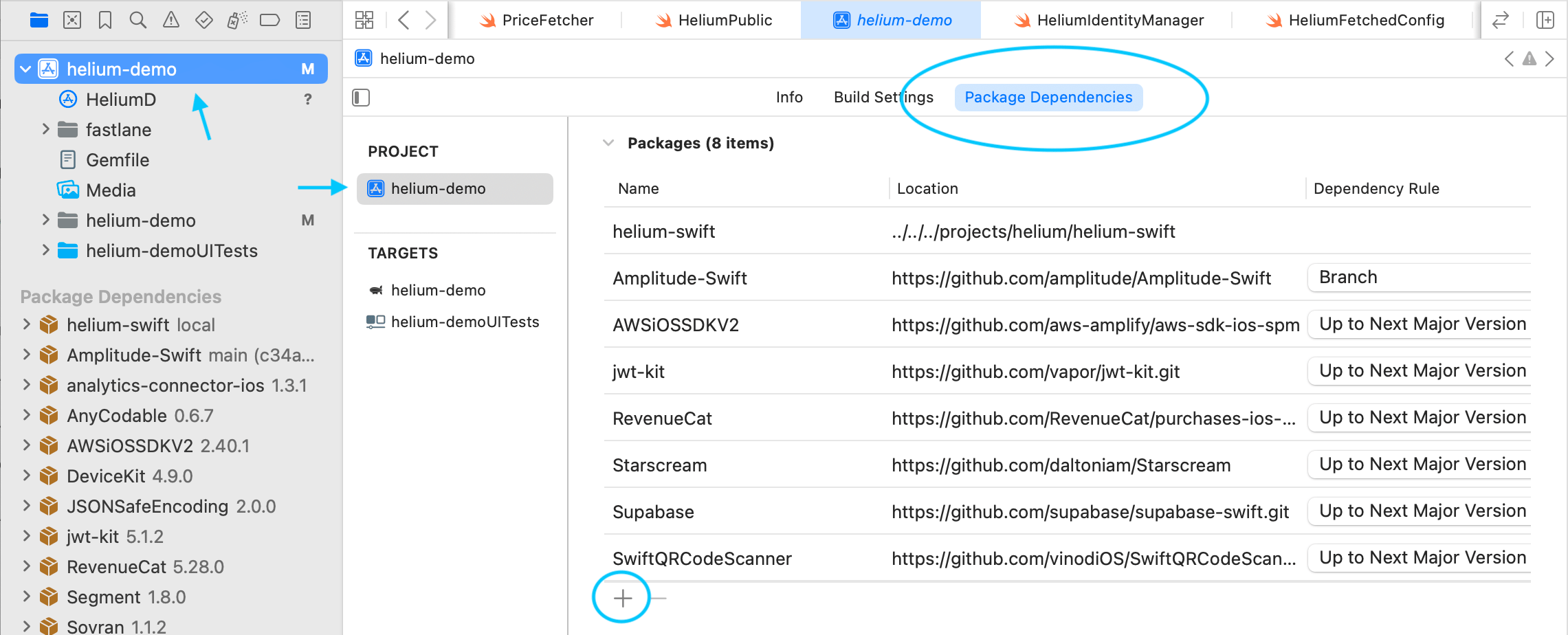 2. Click the **+** button and search for the Helium package URL:
```
https://github.com/cloudcaptainai/helium-swift.git
```
For **Dependency Rule** we recommend the default **Up to Next Major Version** to make sure you get non-breaking bug fixes. View the [list of releases](https://github.com/cloudcaptainai/helium-swift/releases) here.
3. Click **Add Package**.
4. In the dialog that appears, make sure to add the **Helium** product to your app's main target:
2. Click the **+** button and search for the Helium package URL:
```
https://github.com/cloudcaptainai/helium-swift.git
```
For **Dependency Rule** we recommend the default **Up to Next Major Version** to make sure you get non-breaking bug fixes. View the [list of releases](https://github.com/cloudcaptainai/helium-swift/releases) here.
3. Click **Add Package**.
4. In the dialog that appears, make sure to add the **Helium** product to your app's main target:
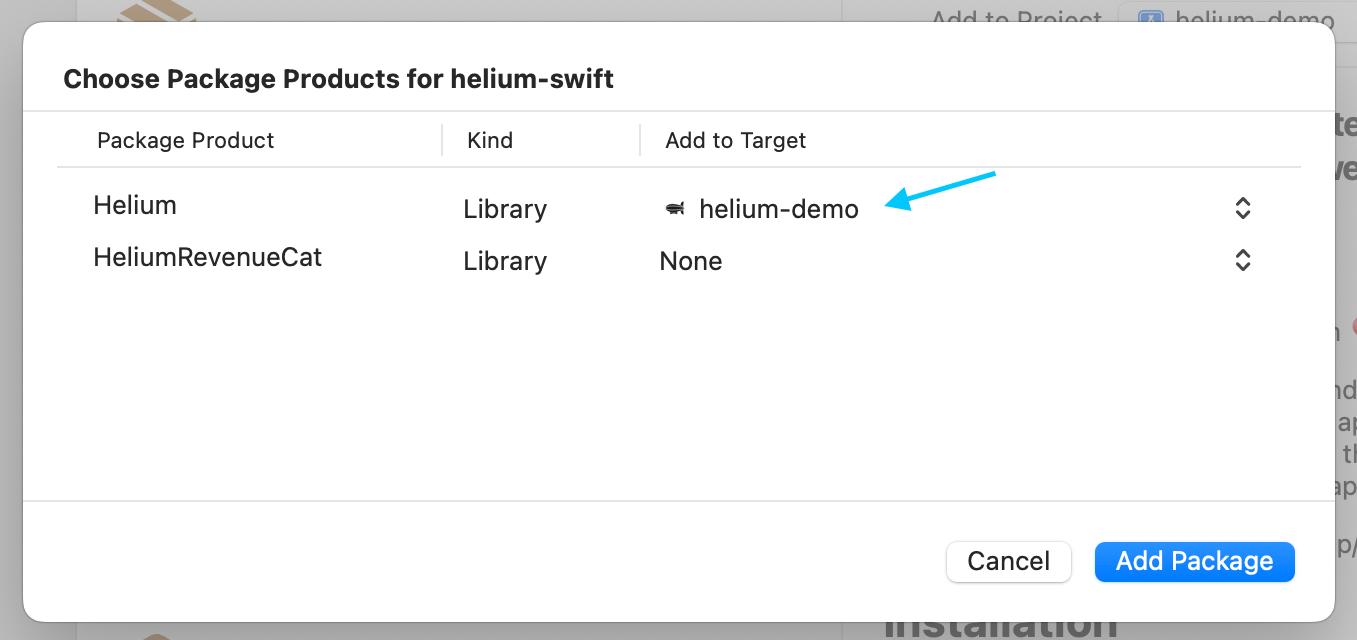 5. *(Optional)* If you are using RevenueCat to manage purchases, we recommended you also add **HeliumRevenueCat** to your target so that you can use our RevenueCatDelegate referenced in the **Purchase Handling** section of this guide. Otherwise leave as **None** for the HeliumRevenueCat row.
The **HeliumRevenueCat** target includes [purchases-ios-spm](https://github.com/RevenueCat/purchases-ios-spm) as a dependency, *not* [purchases-ios](https://github.com/RevenueCat/purchases-ios) and you may encounter build issues if are using **purchases-ios** with SPM. (We recommend just switching to **purchases-ios-spm**).
6. Select **Add Package** in the dialog and Helium should now be ready for import.
### Option 1: Core functionality only
Add this to your Podfile:
```ruby theme={null}
pod 'Helium', '~> 3.0'
```
Then run:
```bash theme={null}
pod install
```
### Option 2: Core + RevenueCat
Recommended if you are using RevenueCat to manage purchases.
Add this to your Podfile:
```ruby theme={null}
pod 'Helium/RevenueCat', '~> 3.0'
```
Then run:
```bash theme={null}
pod install
```
## Initialize Helium
Initialize the Helium SDK as early as possible in your app's lifecycle. Choose the appropriate location based on your app's architecture:
```swift theme={null}
@main
struct MyApp: App {
init() {
// Call Helium.shared.initialize here (see example below)
}
var body: some Scene {
WindowGroup {
ContentView()
}
}
}
```
```swift theme={null}
class SceneDelegate: UIResponder, UIWindowSceneDelegate {
var window: UIWindow?
func scene(_ scene: UIScene, willConnectTo session: UISceneSession, options connectionOptions: UIScene.ConnectionOptions) {
// Call Helium.shared.initialize here (see example below)
}
}
```
```swift theme={null}
@UIApplicationMain
class AppDelegate: UIResponder, UIApplicationDelegate {
var window: UIWindow?
func application(_ application: UIApplication, didFinishLaunchingWithOptions launchOptions: [UIApplication.LaunchOptionsKey: Any]?) -> Bool {
// Call Helium.shared.initialize here (see example below)
return true
}
}
```
Add necessary imports:
```swift theme={null}
import Helium
```
And initialize Helium in the location referenced above:
```swift theme={null}
// Create fallback configuration with a fallback bundle
// (recommended - see Fallbacks and Loading Budgets section)
let fallbackBundleURL = Bundle.main.url(forResource: "fallback-bundle", withExtension: "json")
let fallbackConfig = HeliumFallbackConfig.withFallbackBundle(fallbackBundleURL)
Helium.shared.initialize(
apiKey: "",
fallbackConfig: fallbackConfig,
revenueCatAppUserId: Purchases.shared.appUserID // ONLY if using RevenueCat
)
```
You can create or retrieve your api key from [Account Settings](https://app.tryhelium.com/profile).
Delegate to handle paywall events and callbacks (see next section)
Fallback configuration with either a view or bundle URL. Required parameter.
*(Optional)* If set, a custom user id to use instead of Helium's. We'll use this id when forwarding to third party analytics services, so this can be used for attribution (e.g. an amplitude user id, or a custom user id from your own analytics service)
*(Optional)* Pass in custom user traits to be used for targeting, personalization, and dynamic content. It can be created with any dictionary, as long as the key is a string and the value is a `Codable` type.
```swift theme={null}
let customUserTraits = HeliumUserTraits(traits: [
"testTrait": 1,
"account_age_in_days": "20",
])
```
*(Optional)* Set this if you use a custom appAccountToken with your StoreKit purchases.
*(Optional)* RevenueCat ONLY. Supply RevenueCat appUserID here (and initialize RevenueCat before Helium initialize). You can also set this value outside of initialize: `Helium.shared.setRevenueCatAppUserId(Purchases.shared.appUserID)`
No need to set this if you use RevenueCatDelegate (see next section).
Helium's initialization is ran on a background thread, so you don't have to worry about it affecting your app's launch time.
You can provide a custom user ID and custom user traits in the `initialize` method or by using `Helium.shared.overrideUserId`. Set the user ID and traits before or during `initialize` to ensure consistency in analytics events and for the best experimentation results.
```swift theme={null}
Helium.shared.overrideUserId(
newUserId: "",
traits: HeliumUserTraits? = nil
);
```
In most cases there is no need to check download status. Helium will display a loading indication if a paywall is presented before download has completed.
You can check the status of the paywall configuration download using the `Helium.shared.getDownloadStatus()` method. This method returns a value of type `HeliumFetchedConfigStatus`, which is defined as follows:
```swift theme={null}
public enum HeliumFetchedConfigStatus: String, Codable, Equatable {
case notDownloadedYet
case inProgress
case downloadSuccess
case downloadFailure
}
```
You can also simply check if paywalls have been successfully downloaded with `Helium.shared.paywallsLoaded()`.
## Presenting Paywalls
You must have a trigger and workflow configured in the [dashboard](https://app.tryhelium.com/workflows) in order to show a paywall.
Call `Helium.shared.presentUpsell(trigger:)` when you want to show the paywall. For example:
```swift theme={null}
Button("Try Premium") {
Helium.shared.presentUpsell(trigger: "post_onboarding")
}
```
The trigger name configured in your Helium dashboard
*(Optional)* The view controller to present from. If nil, uses the current top view controller
*(Optional)* Event handlers for paywall lifecycle events
*(Optional)* Custom traits to pass to the paywall
*(Optional)* If `true`, the paywall will not show if the user already has entitlements for any product in the paywall. See the Entitlements section of this guide for more details.
Looking for alternative presentation methods? Check out the guide on [Ways to Show a Paywall](/guides/ways-to-show-paywall).
### PaywallEventHandlers
When displaying a paywall you can pass in event handlers to listen for relevant [Helium Events](/sdk/helium-events). You can chain a subset of handlers with builder syntax:
```swift theme={null}
Helium.shared.presentUpsell(
trigger: "post_onboarding",
eventHandlers: PaywallEventHandlers()
.onOpen { event in
print("open via trigger \(event.triggerName)")
}
.onClose { event in
print("close for trigger \(event.triggerName)")
}
.onDismissed { event in
print("dismiss for trigger \(event.triggerName)")
}
.onPurchaseSucceeded { event in
print("purchase succeeded for trigger \(event.triggerName)")
}
.onOpenFailed {
print("open failed for trigger \(event.triggerName)")
}
.onCustomPaywallAction { event in
print("Custom action: \(event.actionName) with params: \(event.params)")
}
.onAnyEvent { event in
// A handler for all paywall-related events.
// Note that if you have other handlers (i.e. onOpen) set up,
// both that handler AND this one will fire during paywall open.
}
)
```
**Usage Suggestions:**
* Use `onDismiss` for post-paywall navigation when the paywall is dismissed but a user's entitlement hasn't changed
* Use `onPurchaseSucceeded` for your post purchase flow (e.g., a premium onboarding navigation)
* Use `onClose` to handle a paywall close, regardless of reason
You should now be able to see Helium paywalls in your app! Well done! 🎉
## Purchase Handling
By default, Helium will handle purchases for you! This section is for those who want to delegate purchases to RevenueCat or implement custom purchase logic.
Use (or subclass) one of our pre-built `HeliumPaywallDelegate` implementations or create a custom delegate. Pass the delegate in to your `Helium.shared.initialize` call.
The StoreKitDelegate (default delegate) handles purchases using native StoreKit 2:
```swift theme={null}
import Helium
let delegate = StoreKitDelegate()
```
Make sure you included HeliumRevenueCat (for SPM) or Helium/RevenueCat (for Cocoapod) as noted in the Installation section.
RevenueCatDelegate handle purchases through RevenueCat:
```swift theme={null}
import HeliumRevenueCat // unless using Cocoapod then can just import Helium
let delegate = RevenueCatDelegate(
revenueCatApiKey: "" // Optional - pass in to have Helium to handle RevenueCat initialization.
)
```
If you do not supply `revenueCatApiKey`, make sure to initialize RevenueCat *before* initializing Helium!
You can also create a custom delegate and implement your own purchase logic. You can look at our `StoreKitDelegate` and `RevenueCatDelegate` in the SDK for examples (also linked below).
The `HeliumPaywallDelegate` is defined as follows:
```swift theme={null}
public protocol HeliumPaywallDelegate: AnyObject {
// Execute the purchase of a product given the product ID.
func makePurchase(productId: String) async -> HeliumPaywallTransactionStatus
// (Optional) - Restore any existing subscriptions.
// Return a boolean indicating whether the restore was successful.
func restorePurchases() async -> Bool
// (Optional) - Handle Helium Events
func onPaywallEvent(_ event: HeliumEvent)
}
```
`HeliumPaywallTransactionStatus` is an enum that defines the possible states of a paywall transaction:
```swift theme={null}
public enum HeliumPaywallTransactionStatus {
case purchased
case cancelled
case failed(Error)
case restored
case pending
}
```
Visit [Helium Events](/sdk/helium-events) for details on the different Helium paywall events.
When executing the purchase via StoreKit 2 (recommended over StoreKit 1), please use `Product.heliumPurchase()` instead of `Product.purchase()`. For example:
`let result = try await product.heliumPurchase()`
This will automatically set attribution information for [revenue tracking](/guides/revenue-reporting).
StoreKitDelegate example [here](https://github.com/cloudcaptainai/helium-swift/blob/main/Sources/Helium/HeliumCore/StoreKitDelegate.swift).
RevenueCatDelegate example [here](https://github.com/cloudcaptainai/helium-swift/blob/main/Sources/HeliumRevenueCat/HeliumRevenueCat.swift).
## Listen for Helium Events
[Helium Events](/sdk/helium-events) are emitted by Helium for various paywall actions, purchase completions, and more. Options to listen for these events include:
### 1. onPaywallEvent of HeliumPaywallDelegate
Subclass one of the provided `HeliumPaywallDelegate` implementations (see **Purchase Handling** section above) and override `onPaywallEvent`:
```swift theme={null}
class MyStoreKitDelegate: StoreKitDelegate {
override func onPaywallEvent(_ event: HeliumEvent) {
switch event {
case let openEvent as PaywallOpenEvent:
// handle open event here
break
case let closeEvent as PaywallCloseEvent:
break
case let dismissEvent as PaywallDismissedEvent:
break
case let purchaseEvent as PurchaseSucceededEvent:
break
default:
break
}
}
}
```
Make sure to pass your delegate in to `Helium.shared.initialize`!
### 2. Add a HeliumEventListener
```swift theme={null}
/// Implement this where you want to handle events
public protocol HeliumEventListener : AnyObject {
func onHeliumEvent(event: HeliumEvent)
}
/// Add a listener for all Helium events. Listeners are stored weakly, so if you create a listener inline it may not be retained.
public func addHeliumEventListener(_ listener: HeliumEventListener)
/// Remove a specific Helium event listener.
public func removeHeliumEventListener(_ listener: HeliumEventListener)
```
### 3. Use PaywallEventHandlers for paywall-specific events
See the section titled PaywallEventHandlers on this page.
## Checking Subscription Status & Entitlements
The Helium SDK provides several ways to check user entitlements and subscription status.
`hasAnyEntitlement()` Checks if the user has purchased any subscription or non-consumable product.
`hasAnyActiveSubscription(includeNonRenewing: Bool = true)` Checks if the user has any active subscription. Set `includeNonRenewing` to `false` to check only auto-renewing subscriptions.
`hasEntitlementForPaywall(trigger: String, considerAssociatedSubscriptions: Bool = false)` Checks if the user has entitlements for any product in a specific paywall. Returns `nil` if paywall configuration hasn't been downloaded yet.
`hasActiveEntitlementFor(productId: String)` Checks if the user has entitlement to a specific product.
`hasActiveSubscriptionFor(productId: String)` Checks if the user has an active subscription for a specific product.
`hasActiveSubscriptionFor(subscriptionGroupID: String)` Checks if the user has an active subscription in a specific subscription group.
`purchasedProductIds()` Retrieves a list of all product IDs the user currently has access to.
`activeSubscriptions()` Returns detailed information about all active auto-renewing subscriptions.
`subscriptionStatusFor(productId: String)` Gets detailed subscription status for a specific product, including state information like subscribed, expired, or in grace period.
`subscriptionStatusFor(subscriptionGroupID: String)` Gets detailed subscription status for a specific subscription group.
#### Example Usage
Check entitlements before showing paywalls to avoid showing a paywall to a user who should not see it.
```swift Use dontShowIfAlreadyEntitled with presentUpsell theme={null}
Helium.shared.presentUpsell(trigger: "my_paywall", dontShowIfAlreadyEntitled: true)
```
```swift Check before showing paywall theme={null}
let heliumTrigger = "my_paywall"
let hasActiveSubscription = await Helium.shared.hasAnyActiveSubscription()
if hasActiveSubscription {
// access premium content
} else {
// show paywall
Helium.shared.presentUpsell(
trigger: heliumTrigger,
eventHandlers: PaywallEventHandlers()
.onPurchaseSucceeded { _ in
// access premium content
}
)
}
```
## Fallbacks and Loading Budgets
If a paywall has not completed downloading when you attempt to present it, a loading state can show.
By default, Helium will show this loading state as needed (a shimmer view for up to 7 seconds). You can configure, turn off, or set trigger-specific loading budgets.
If the budget expires before the paywall is ready, a fallback paywall will show if available otherwise the loading state will hide and a [PaywallOpenFailed](/sdk/helium-events) event will be dispatched.
The iOS sdk has 3 options for fallbacks:
1. [Fallback bundles](/guides/fallback-bundle)
2. Default fallback view
3. Fallback view per trigger
All of this is configured via the `HeliumFallbackConfig` object passed in to `initialize`. Here are some examples:
```swift theme={null}
// Just provide a fallback bundle
let fallbackBundleURL = Bundle.main.url(
forResource: "fallback-bundle-xxxx-xx-xx",
withExtension: "json"
)
let fallbackConfig = HeliumFallbackConfig.withFallbackBundle(fallbackBundleURL)
// Provide fallback view and configure loading budgets
let fallbackConfig = HeliumFallbackConfig(
fallbackView: YourFallbackView(),
// Global loading budget (in seconds)
loadingBudget: 5.0,
// Per-trigger loading budgets
perTriggerLoadingConfig: [
"onboarding": TriggerLoadingConfig(loadingBudget: 4),
"quick_upgrade": TriggerLoadingConfig(useLoadingState: false),
]
)
Helium.shared.initialize(
apiKey: "your-api-key",
fallbackConfig: fallbackConfig
)
```
## Advanced
Retrieve basic information about the paywall for a specific trigger with `Helium.shared.getPaywallInfo(trigger: String)` which returns:
```swift theme={null}
public struct PaywallInfo {
public let paywallTemplateName: String
// shouldShow only false if the paywall should not be shown due to targeting or workflow configuration (Helium handles this for you in presentUpsell)
public let shouldShow: Bool
}
```
This method can be used if you want to be certain that a paywall is ready for display before displaying.
Reset Helium entirely so you can call initialize again. Only for advanced use cases.
```swift theme={null}
Helium.resetHelium()
```
5. *(Optional)* If you are using RevenueCat to manage purchases, we recommended you also add **HeliumRevenueCat** to your target so that you can use our RevenueCatDelegate referenced in the **Purchase Handling** section of this guide. Otherwise leave as **None** for the HeliumRevenueCat row.
The **HeliumRevenueCat** target includes [purchases-ios-spm](https://github.com/RevenueCat/purchases-ios-spm) as a dependency, *not* [purchases-ios](https://github.com/RevenueCat/purchases-ios) and you may encounter build issues if are using **purchases-ios** with SPM. (We recommend just switching to **purchases-ios-spm**).
6. Select **Add Package** in the dialog and Helium should now be ready for import.
### Option 1: Core functionality only
Add this to your Podfile:
```ruby theme={null}
pod 'Helium', '~> 3.0'
```
Then run:
```bash theme={null}
pod install
```
### Option 2: Core + RevenueCat
Recommended if you are using RevenueCat to manage purchases.
Add this to your Podfile:
```ruby theme={null}
pod 'Helium/RevenueCat', '~> 3.0'
```
Then run:
```bash theme={null}
pod install
```
## Initialize Helium
Initialize the Helium SDK as early as possible in your app's lifecycle. Choose the appropriate location based on your app's architecture:
```swift theme={null}
@main
struct MyApp: App {
init() {
// Call Helium.shared.initialize here (see example below)
}
var body: some Scene {
WindowGroup {
ContentView()
}
}
}
```
```swift theme={null}
class SceneDelegate: UIResponder, UIWindowSceneDelegate {
var window: UIWindow?
func scene(_ scene: UIScene, willConnectTo session: UISceneSession, options connectionOptions: UIScene.ConnectionOptions) {
// Call Helium.shared.initialize here (see example below)
}
}
```
```swift theme={null}
@UIApplicationMain
class AppDelegate: UIResponder, UIApplicationDelegate {
var window: UIWindow?
func application(_ application: UIApplication, didFinishLaunchingWithOptions launchOptions: [UIApplication.LaunchOptionsKey: Any]?) -> Bool {
// Call Helium.shared.initialize here (see example below)
return true
}
}
```
Add necessary imports:
```swift theme={null}
import Helium
```
And initialize Helium in the location referenced above:
```swift theme={null}
// Create fallback configuration with a fallback bundle
// (recommended - see Fallbacks and Loading Budgets section)
let fallbackBundleURL = Bundle.main.url(forResource: "fallback-bundle", withExtension: "json")
let fallbackConfig = HeliumFallbackConfig.withFallbackBundle(fallbackBundleURL)
Helium.shared.initialize(
apiKey: "",
fallbackConfig: fallbackConfig,
revenueCatAppUserId: Purchases.shared.appUserID // ONLY if using RevenueCat
)
```
You can create or retrieve your api key from [Account Settings](https://app.tryhelium.com/profile).
Delegate to handle paywall events and callbacks (see next section)
Fallback configuration with either a view or bundle URL. Required parameter.
*(Optional)* If set, a custom user id to use instead of Helium's. We'll use this id when forwarding to third party analytics services, so this can be used for attribution (e.g. an amplitude user id, or a custom user id from your own analytics service)
*(Optional)* Pass in custom user traits to be used for targeting, personalization, and dynamic content. It can be created with any dictionary, as long as the key is a string and the value is a `Codable` type.
```swift theme={null}
let customUserTraits = HeliumUserTraits(traits: [
"testTrait": 1,
"account_age_in_days": "20",
])
```
*(Optional)* Set this if you use a custom appAccountToken with your StoreKit purchases.
*(Optional)* RevenueCat ONLY. Supply RevenueCat appUserID here (and initialize RevenueCat before Helium initialize). You can also set this value outside of initialize: `Helium.shared.setRevenueCatAppUserId(Purchases.shared.appUserID)`
No need to set this if you use RevenueCatDelegate (see next section).
Helium's initialization is ran on a background thread, so you don't have to worry about it affecting your app's launch time.
You can provide a custom user ID and custom user traits in the `initialize` method or by using `Helium.shared.overrideUserId`. Set the user ID and traits before or during `initialize` to ensure consistency in analytics events and for the best experimentation results.
```swift theme={null}
Helium.shared.overrideUserId(
newUserId: "",
traits: HeliumUserTraits? = nil
);
```
In most cases there is no need to check download status. Helium will display a loading indication if a paywall is presented before download has completed.
You can check the status of the paywall configuration download using the `Helium.shared.getDownloadStatus()` method. This method returns a value of type `HeliumFetchedConfigStatus`, which is defined as follows:
```swift theme={null}
public enum HeliumFetchedConfigStatus: String, Codable, Equatable {
case notDownloadedYet
case inProgress
case downloadSuccess
case downloadFailure
}
```
You can also simply check if paywalls have been successfully downloaded with `Helium.shared.paywallsLoaded()`.
## Presenting Paywalls
You must have a trigger and workflow configured in the [dashboard](https://app.tryhelium.com/workflows) in order to show a paywall.
Call `Helium.shared.presentUpsell(trigger:)` when you want to show the paywall. For example:
```swift theme={null}
Button("Try Premium") {
Helium.shared.presentUpsell(trigger: "post_onboarding")
}
```
The trigger name configured in your Helium dashboard
*(Optional)* The view controller to present from. If nil, uses the current top view controller
*(Optional)* Event handlers for paywall lifecycle events
*(Optional)* Custom traits to pass to the paywall
*(Optional)* If `true`, the paywall will not show if the user already has entitlements for any product in the paywall. See the Entitlements section of this guide for more details.
Looking for alternative presentation methods? Check out the guide on [Ways to Show a Paywall](/guides/ways-to-show-paywall).
### PaywallEventHandlers
When displaying a paywall you can pass in event handlers to listen for relevant [Helium Events](/sdk/helium-events). You can chain a subset of handlers with builder syntax:
```swift theme={null}
Helium.shared.presentUpsell(
trigger: "post_onboarding",
eventHandlers: PaywallEventHandlers()
.onOpen { event in
print("open via trigger \(event.triggerName)")
}
.onClose { event in
print("close for trigger \(event.triggerName)")
}
.onDismissed { event in
print("dismiss for trigger \(event.triggerName)")
}
.onPurchaseSucceeded { event in
print("purchase succeeded for trigger \(event.triggerName)")
}
.onOpenFailed {
print("open failed for trigger \(event.triggerName)")
}
.onCustomPaywallAction { event in
print("Custom action: \(event.actionName) with params: \(event.params)")
}
.onAnyEvent { event in
// A handler for all paywall-related events.
// Note that if you have other handlers (i.e. onOpen) set up,
// both that handler AND this one will fire during paywall open.
}
)
```
**Usage Suggestions:**
* Use `onDismiss` for post-paywall navigation when the paywall is dismissed but a user's entitlement hasn't changed
* Use `onPurchaseSucceeded` for your post purchase flow (e.g., a premium onboarding navigation)
* Use `onClose` to handle a paywall close, regardless of reason
You should now be able to see Helium paywalls in your app! Well done! 🎉
## Purchase Handling
By default, Helium will handle purchases for you! This section is for those who want to delegate purchases to RevenueCat or implement custom purchase logic.
Use (or subclass) one of our pre-built `HeliumPaywallDelegate` implementations or create a custom delegate. Pass the delegate in to your `Helium.shared.initialize` call.
The StoreKitDelegate (default delegate) handles purchases using native StoreKit 2:
```swift theme={null}
import Helium
let delegate = StoreKitDelegate()
```
Make sure you included HeliumRevenueCat (for SPM) or Helium/RevenueCat (for Cocoapod) as noted in the Installation section.
RevenueCatDelegate handle purchases through RevenueCat:
```swift theme={null}
import HeliumRevenueCat // unless using Cocoapod then can just import Helium
let delegate = RevenueCatDelegate(
revenueCatApiKey: "" // Optional - pass in to have Helium to handle RevenueCat initialization.
)
```
If you do not supply `revenueCatApiKey`, make sure to initialize RevenueCat *before* initializing Helium!
You can also create a custom delegate and implement your own purchase logic. You can look at our `StoreKitDelegate` and `RevenueCatDelegate` in the SDK for examples (also linked below).
The `HeliumPaywallDelegate` is defined as follows:
```swift theme={null}
public protocol HeliumPaywallDelegate: AnyObject {
// Execute the purchase of a product given the product ID.
func makePurchase(productId: String) async -> HeliumPaywallTransactionStatus
// (Optional) - Restore any existing subscriptions.
// Return a boolean indicating whether the restore was successful.
func restorePurchases() async -> Bool
// (Optional) - Handle Helium Events
func onPaywallEvent(_ event: HeliumEvent)
}
```
`HeliumPaywallTransactionStatus` is an enum that defines the possible states of a paywall transaction:
```swift theme={null}
public enum HeliumPaywallTransactionStatus {
case purchased
case cancelled
case failed(Error)
case restored
case pending
}
```
Visit [Helium Events](/sdk/helium-events) for details on the different Helium paywall events.
When executing the purchase via StoreKit 2 (recommended over StoreKit 1), please use `Product.heliumPurchase()` instead of `Product.purchase()`. For example:
`let result = try await product.heliumPurchase()`
This will automatically set attribution information for [revenue tracking](/guides/revenue-reporting).
StoreKitDelegate example [here](https://github.com/cloudcaptainai/helium-swift/blob/main/Sources/Helium/HeliumCore/StoreKitDelegate.swift).
RevenueCatDelegate example [here](https://github.com/cloudcaptainai/helium-swift/blob/main/Sources/HeliumRevenueCat/HeliumRevenueCat.swift).
## Listen for Helium Events
[Helium Events](/sdk/helium-events) are emitted by Helium for various paywall actions, purchase completions, and more. Options to listen for these events include:
### 1. onPaywallEvent of HeliumPaywallDelegate
Subclass one of the provided `HeliumPaywallDelegate` implementations (see **Purchase Handling** section above) and override `onPaywallEvent`:
```swift theme={null}
class MyStoreKitDelegate: StoreKitDelegate {
override func onPaywallEvent(_ event: HeliumEvent) {
switch event {
case let openEvent as PaywallOpenEvent:
// handle open event here
break
case let closeEvent as PaywallCloseEvent:
break
case let dismissEvent as PaywallDismissedEvent:
break
case let purchaseEvent as PurchaseSucceededEvent:
break
default:
break
}
}
}
```
Make sure to pass your delegate in to `Helium.shared.initialize`!
### 2. Add a HeliumEventListener
```swift theme={null}
/// Implement this where you want to handle events
public protocol HeliumEventListener : AnyObject {
func onHeliumEvent(event: HeliumEvent)
}
/// Add a listener for all Helium events. Listeners are stored weakly, so if you create a listener inline it may not be retained.
public func addHeliumEventListener(_ listener: HeliumEventListener)
/// Remove a specific Helium event listener.
public func removeHeliumEventListener(_ listener: HeliumEventListener)
```
### 3. Use PaywallEventHandlers for paywall-specific events
See the section titled PaywallEventHandlers on this page.
## Checking Subscription Status & Entitlements
The Helium SDK provides several ways to check user entitlements and subscription status.
`hasAnyEntitlement()` Checks if the user has purchased any subscription or non-consumable product.
`hasAnyActiveSubscription(includeNonRenewing: Bool = true)` Checks if the user has any active subscription. Set `includeNonRenewing` to `false` to check only auto-renewing subscriptions.
`hasEntitlementForPaywall(trigger: String, considerAssociatedSubscriptions: Bool = false)` Checks if the user has entitlements for any product in a specific paywall. Returns `nil` if paywall configuration hasn't been downloaded yet.
`hasActiveEntitlementFor(productId: String)` Checks if the user has entitlement to a specific product.
`hasActiveSubscriptionFor(productId: String)` Checks if the user has an active subscription for a specific product.
`hasActiveSubscriptionFor(subscriptionGroupID: String)` Checks if the user has an active subscription in a specific subscription group.
`purchasedProductIds()` Retrieves a list of all product IDs the user currently has access to.
`activeSubscriptions()` Returns detailed information about all active auto-renewing subscriptions.
`subscriptionStatusFor(productId: String)` Gets detailed subscription status for a specific product, including state information like subscribed, expired, or in grace period.
`subscriptionStatusFor(subscriptionGroupID: String)` Gets detailed subscription status for a specific subscription group.
#### Example Usage
Check entitlements before showing paywalls to avoid showing a paywall to a user who should not see it.
```swift Use dontShowIfAlreadyEntitled with presentUpsell theme={null}
Helium.shared.presentUpsell(trigger: "my_paywall", dontShowIfAlreadyEntitled: true)
```
```swift Check before showing paywall theme={null}
let heliumTrigger = "my_paywall"
let hasActiveSubscription = await Helium.shared.hasAnyActiveSubscription()
if hasActiveSubscription {
// access premium content
} else {
// show paywall
Helium.shared.presentUpsell(
trigger: heliumTrigger,
eventHandlers: PaywallEventHandlers()
.onPurchaseSucceeded { _ in
// access premium content
}
)
}
```
## Fallbacks and Loading Budgets
If a paywall has not completed downloading when you attempt to present it, a loading state can show.
By default, Helium will show this loading state as needed (a shimmer view for up to 7 seconds). You can configure, turn off, or set trigger-specific loading budgets.
If the budget expires before the paywall is ready, a fallback paywall will show if available otherwise the loading state will hide and a [PaywallOpenFailed](/sdk/helium-events) event will be dispatched.
The iOS sdk has 3 options for fallbacks:
1. [Fallback bundles](/guides/fallback-bundle)
2. Default fallback view
3. Fallback view per trigger
All of this is configured via the `HeliumFallbackConfig` object passed in to `initialize`. Here are some examples:
```swift theme={null}
// Just provide a fallback bundle
let fallbackBundleURL = Bundle.main.url(
forResource: "fallback-bundle-xxxx-xx-xx",
withExtension: "json"
)
let fallbackConfig = HeliumFallbackConfig.withFallbackBundle(fallbackBundleURL)
// Provide fallback view and configure loading budgets
let fallbackConfig = HeliumFallbackConfig(
fallbackView: YourFallbackView(),
// Global loading budget (in seconds)
loadingBudget: 5.0,
// Per-trigger loading budgets
perTriggerLoadingConfig: [
"onboarding": TriggerLoadingConfig(loadingBudget: 4),
"quick_upgrade": TriggerLoadingConfig(useLoadingState: false),
]
)
Helium.shared.initialize(
apiKey: "your-api-key",
fallbackConfig: fallbackConfig
)
```
## Advanced
Retrieve basic information about the paywall for a specific trigger with `Helium.shared.getPaywallInfo(trigger: String)` which returns:
```swift theme={null}
public struct PaywallInfo {
public let paywallTemplateName: String
// shouldShow only false if the paywall should not be shown due to targeting or workflow configuration (Helium handles this for you in presentUpsell)
public let shouldShow: Bool
}
```
This method can be used if you want to be certain that a paywall is ready for display before displaying.
Reset Helium entirely so you can call initialize again. Only for advanced use cases.
```swift theme={null}
Helium.resetHelium()
```